Hardie or Vinyl? A Charlotte Contractor’s Take on Cost, Installers and Bad Installs
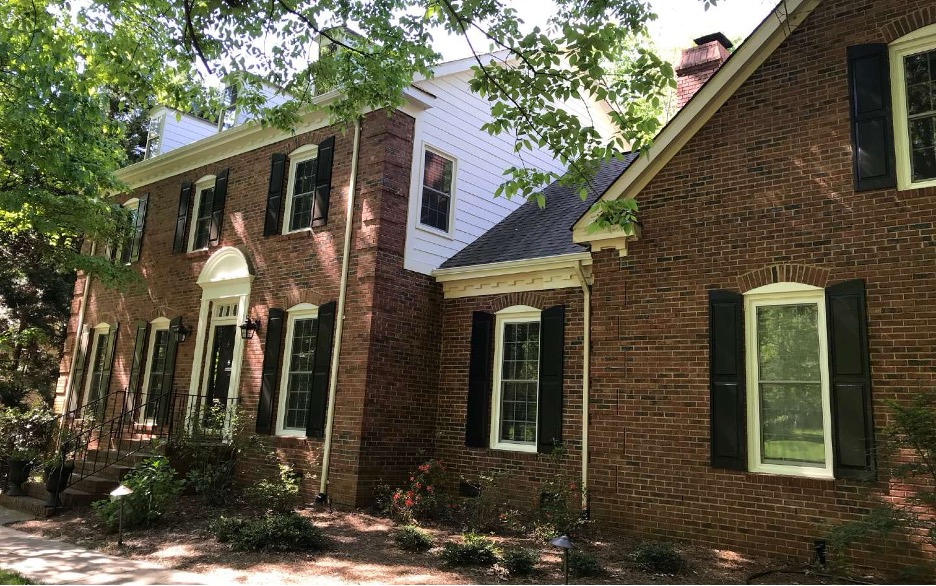
Picture a 1990s two-story off Providence Road. The vinyl on the west wall has faded a couple shades past the side that faces the neighbors, there’s a ripple in the panels by the back deck from the summer somebody parked the grill too close, and you can push a screwdriver into the window trim without trying very hard. We walk houses like this every week. Funny enough, almost nobody wants to talk colors first. They want to know if Hardie is worth the extra money, or if they should just go back with vinyl.
We get it. The answer we give most people is a little unsatisfying at first: it depends on the house, how long you’ll live there, and frankly, who’s doing the install. We install both at Belk Builders, so we don’t have a reason to push you one way. What we’ve learned over a lot of Charlotte jobs is that the material decision is only half of it. A great product put on badly will cost you more than a modest product put on right.
So this guide covers three things in order:
1. What Hardie Plank and vinyl siding actually cost in the Charlotte area, upfront and over time
2. How to choose a Hardie Plank installer without getting burned
3. The warning signs that a Hardie job was installed incorrectly, whether it’s a quote you’re reviewing or siding that’s already on your house
Part 1: Hardie Plank vs. Vinyl Siding Cost in Charlotte
In the Charlotte market, Hardie Plank usually costs somewhere between 20% and 100% more than vinyl to install, depending on which vinyl you compare it to. Yes, that’s a big range. It’s also why those national “average cost” pages leave people scratching their heads. The thin builder-grade vinyl on a lot of ’90s subdivisions and a thick insulated panel aren’t really the same product, and you could say the same about primed Hardie sitting next to ColorPlus.
The Charlotte-specific numbers
The best local data point we know of is the annual Cost vs. Value report published by the Journal of Light Construction. It prices the same standardized siding job (roughly 1,250 square feet of siding, with tear- off and trim) in each metro. For Charlotte in 2025:
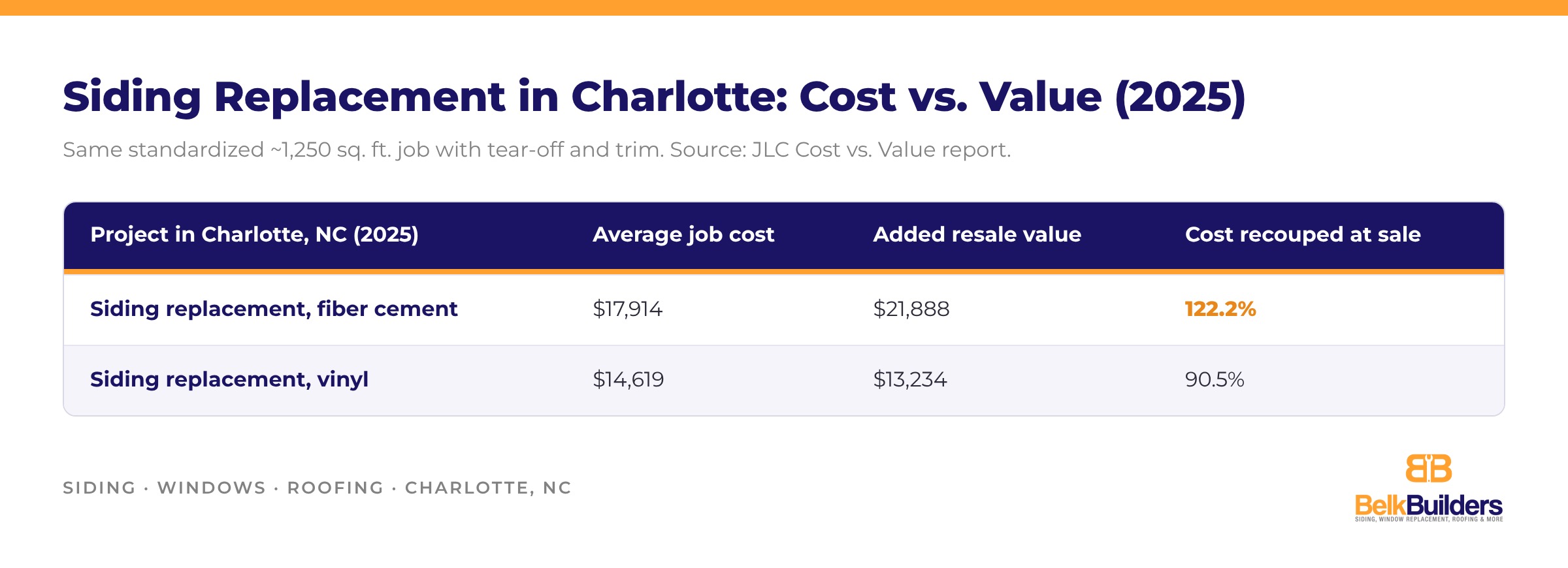
Two things jump out. First, on that standard job, fiber cement ran only about $3,300 more than vinyl here. Second (and this one surprises a lot of our clients), fiber cement paid back more than it cost at resale. Only a handful of projects on the whole list managed that. Vinyl got back roughly 90 cents for every dollar spent
One catch: 1,250 square feet is a small house by our standards. Out in Ballantyne or Weddington, or up around Lake Norman, we regularly measure 2,500 to 4,000 square feet of wall, and that’s before you count the gables, the bump-outs and the second-story walls where we have to set up staging. Those homes cost more for either material.
Typical installed price per square foot
These are the planning ranges we’d give a Charlotte homeowner before we’ve seen the house. They include tear-off, house wrap, standard trim and cleanup. They do not include rotted sheathing repair, which we can’t price until the old siding is off.
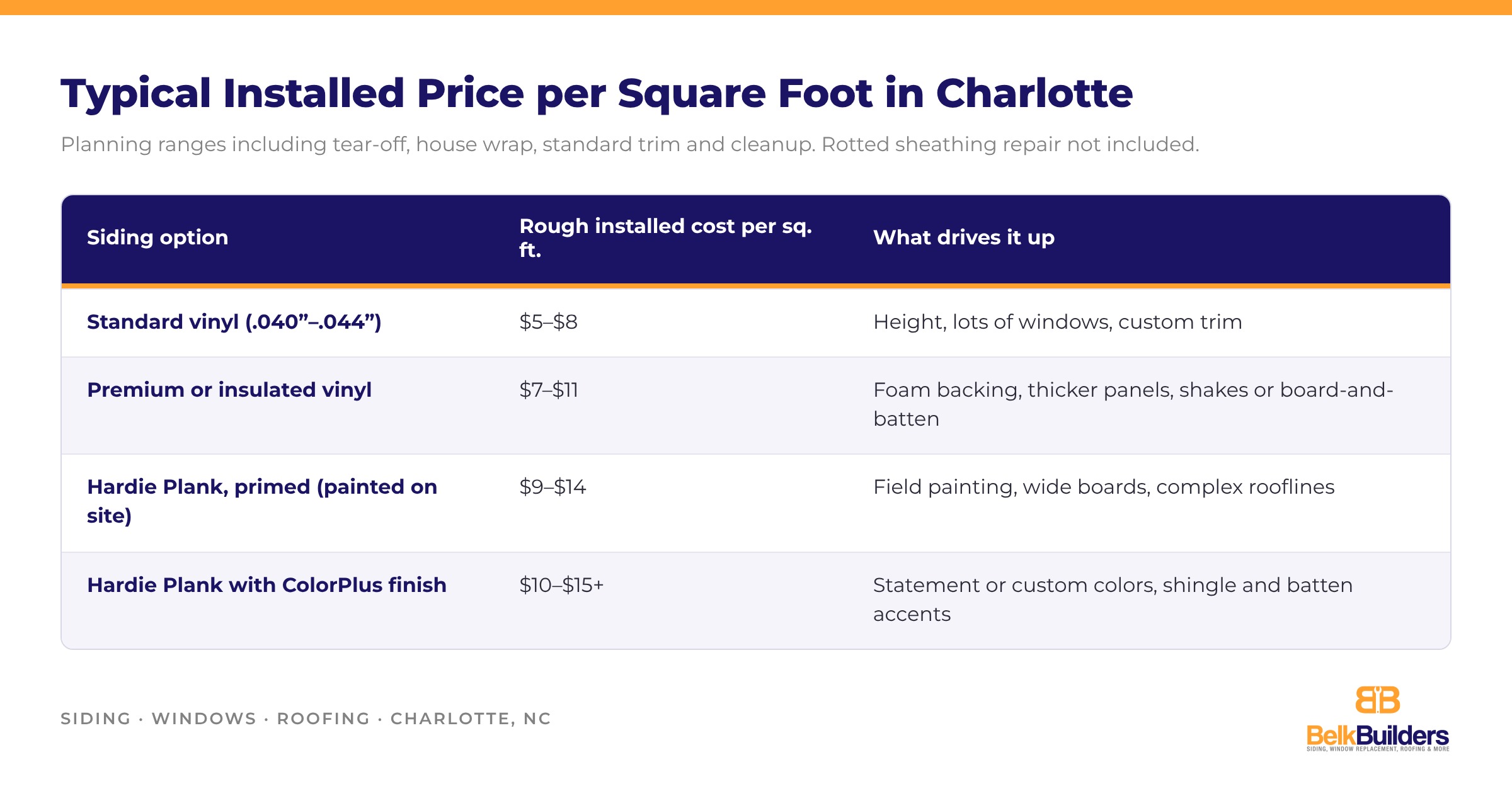
National guides line up roughly with this. HomeAdvisor puts fiber cement at $5 to $14 a square foot installed and vinyl at $3 to $12, and Charlotte usually lands in the middle to upper part of those ranges because of how many two-story homes we have.
Why Hardie costs more to put on
Some of it is the boards themselves. Most of it is labor. A square foot of fiber cement weighs around two and a half pounds, so a 12-foot plank is a two-man carry up the ladder (ask our guys how their shoulders feel on a Friday). Cuts need dust-collecting saws or shears. Every butt joint gets a piece of flashing tucked behind it, and the nails have to land at set distances from the edges or the board can crack. Vinyl is a different animal. It snaps together and hangs loose on the nail so it can expand and contract in the
heat. A solid vinyl crew will just finish a house faster than a solid Hardie crew, and you’ll see that in the bid.
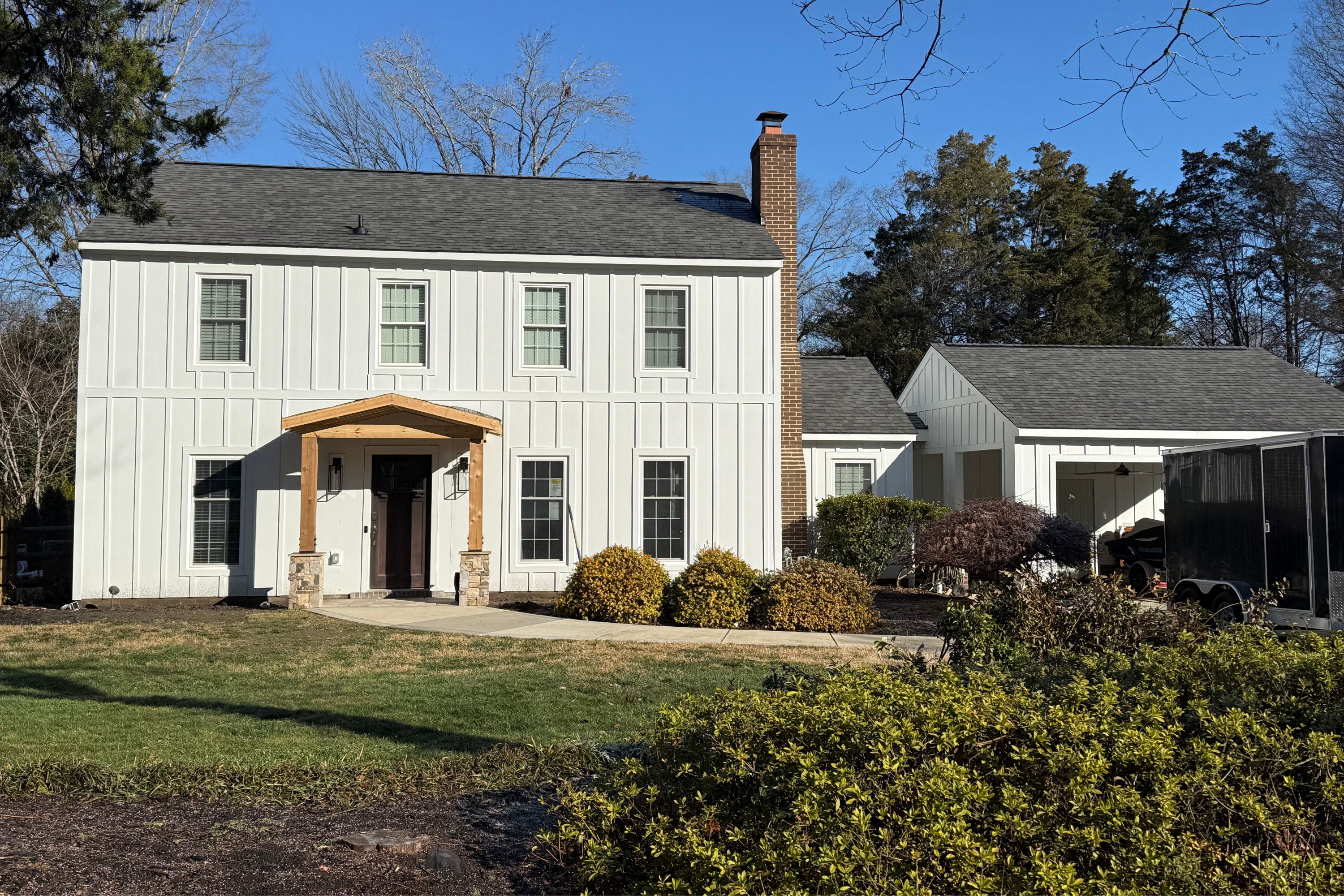
What it costs to own, year after year
The check you write on install day isn’t the whole story. Here’s how the two compare once they’re on the house:
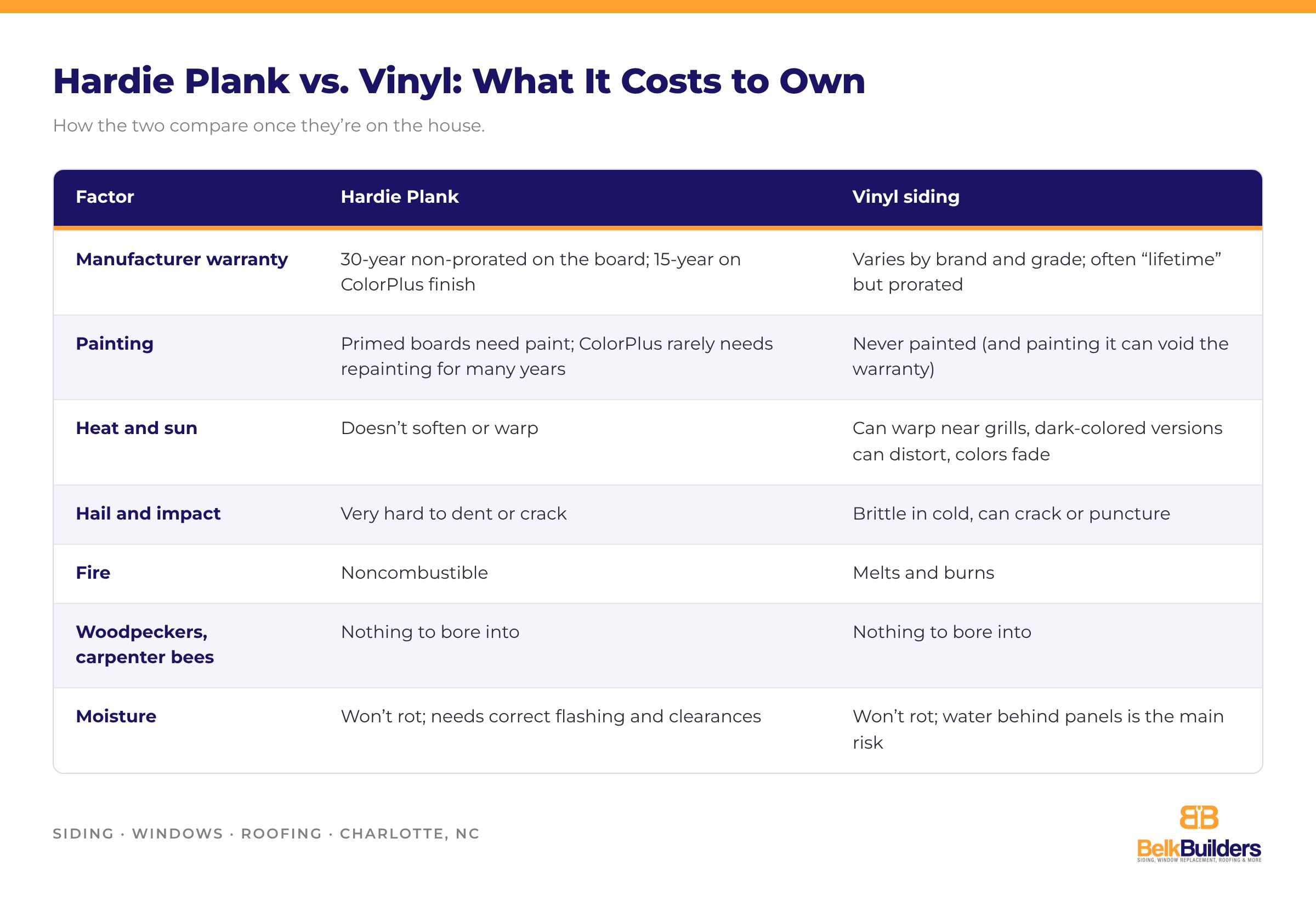
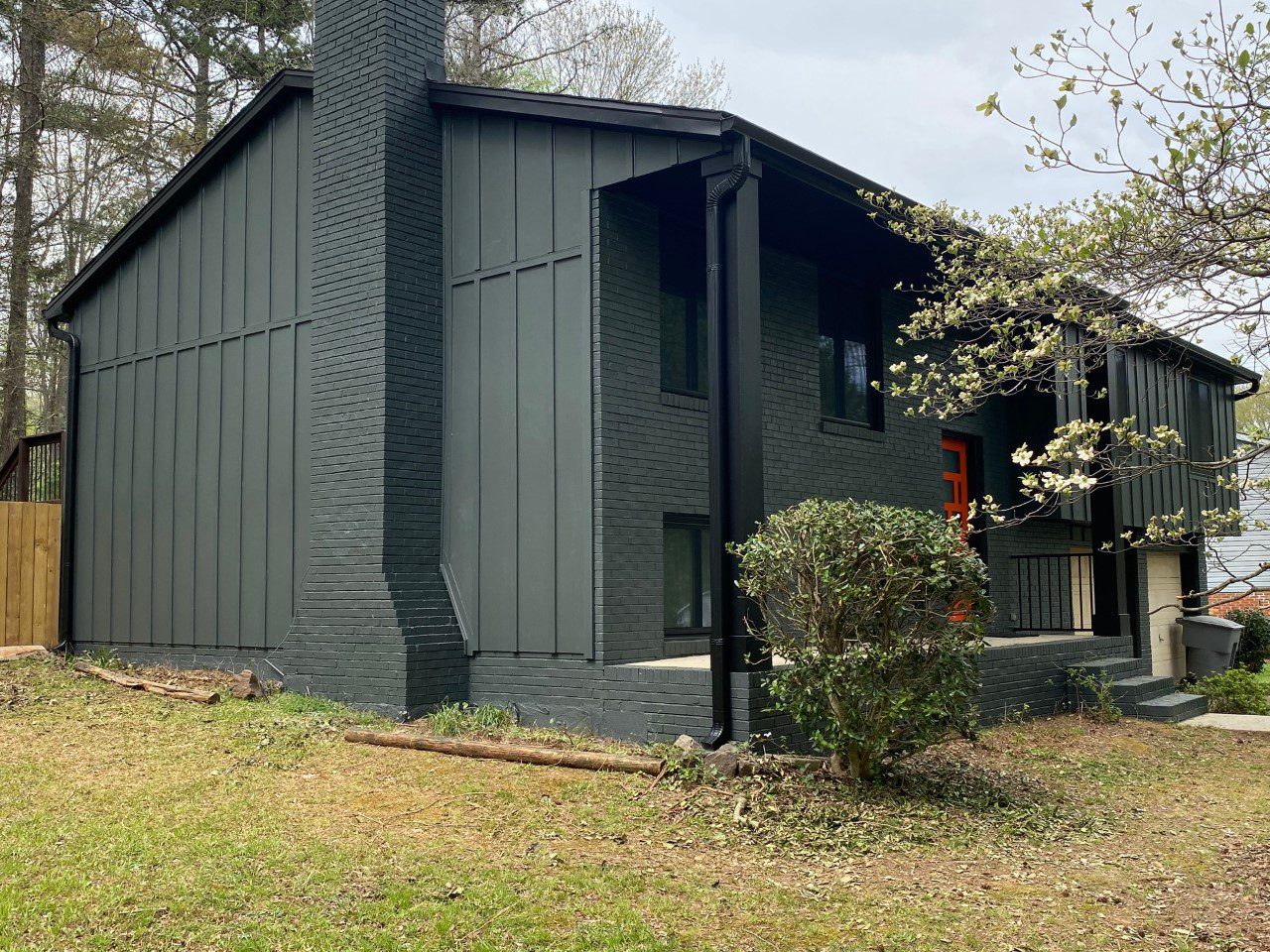
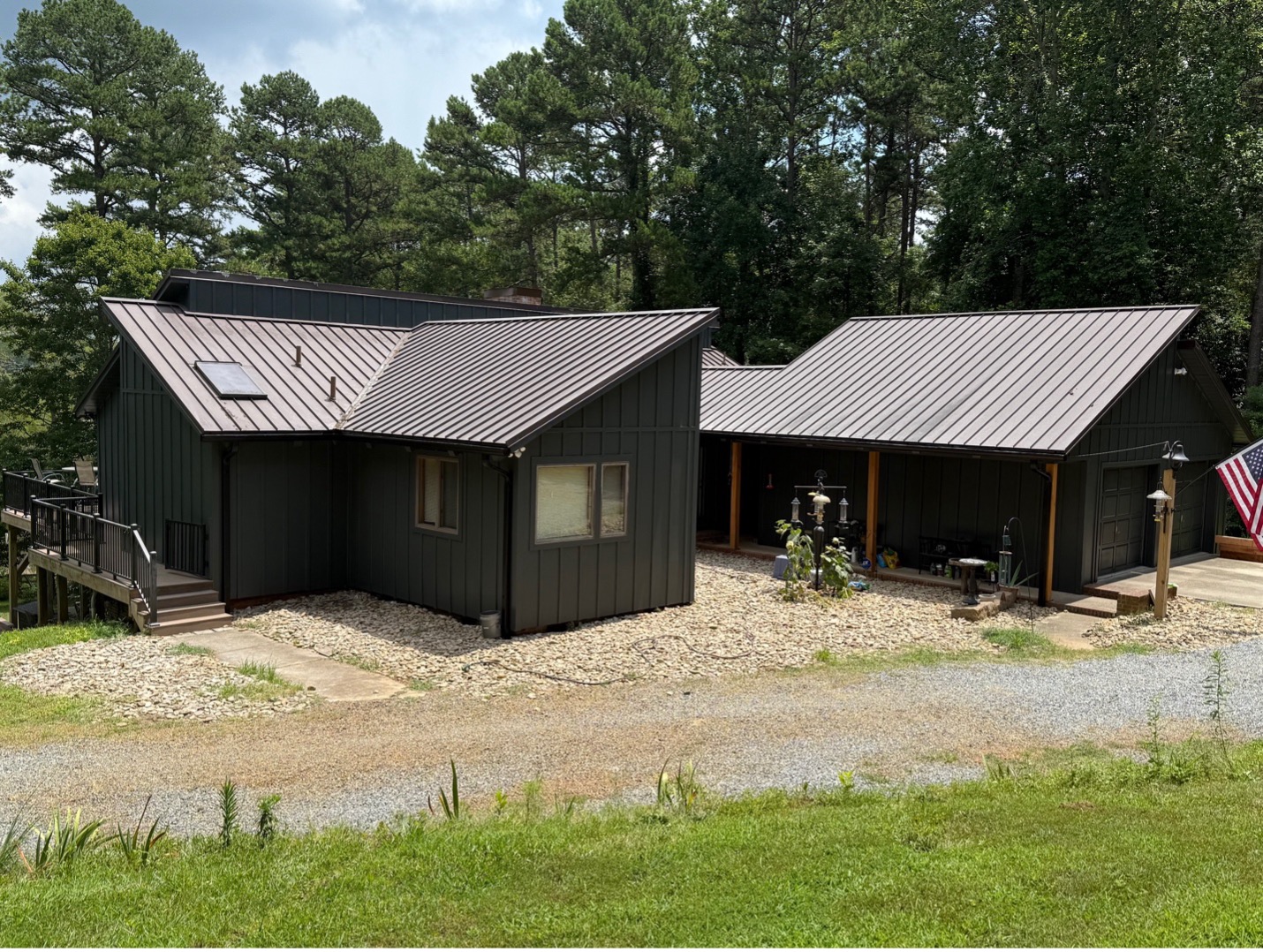
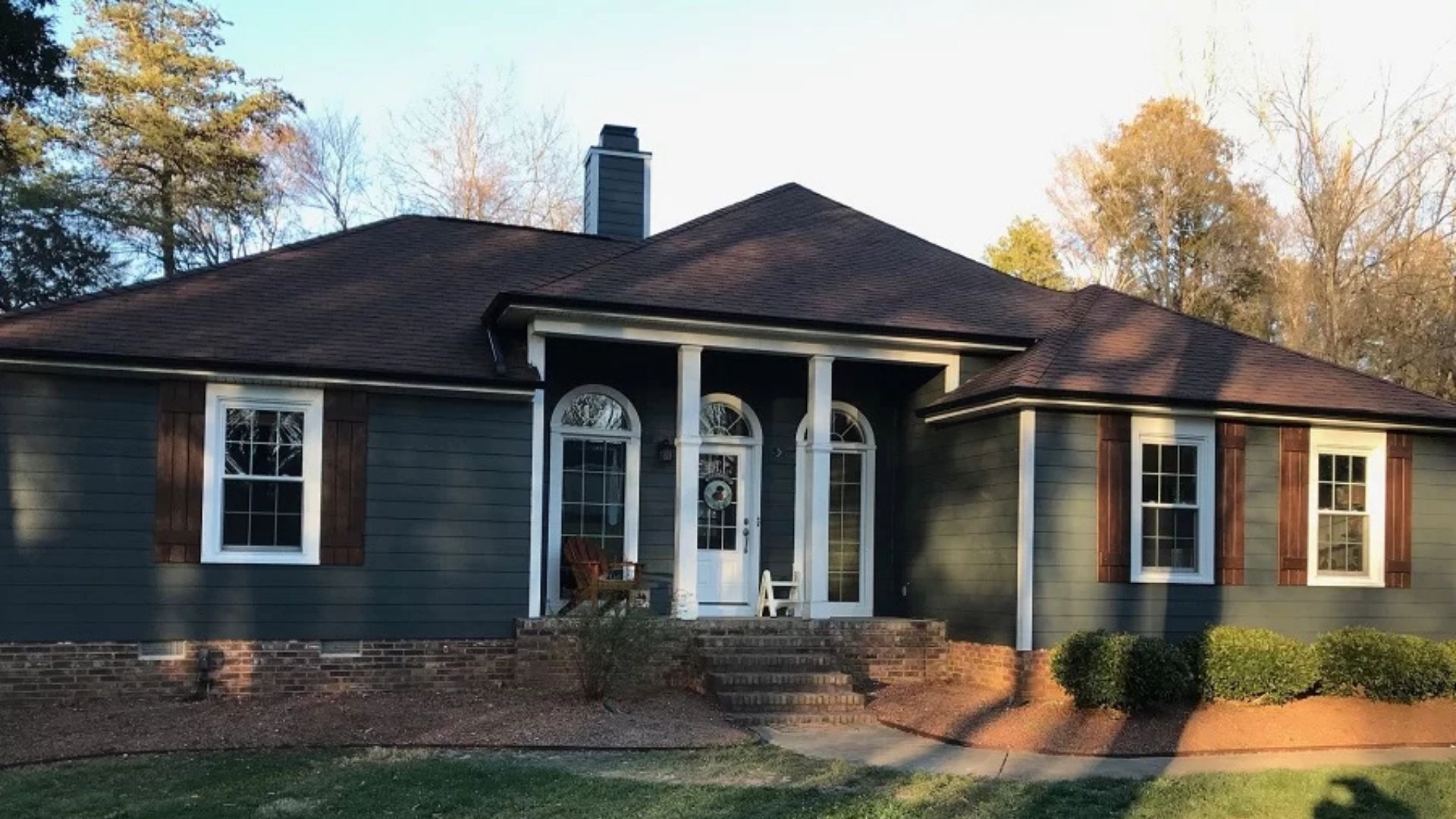
If you go with primed Hardie and paint it on site, budget for a repaint somewhere in the 10 to 15 year range. ColorPlus costs more on day one but takes most of that repaint cycle off the table, which is why we recommend it for the majority of our Hardie jobs. If you like the idea of a dark color, Hardie’s 2026 Color of the Year, Iron Gray is a good example of a shade that holds up far better as a baked-on finish than as field paint.
How Charlotte’s climate tips the scales
If you’ve lived here a few years, you know the drill: sticky July afternoons, January nights that dip below freezing and bounce back by lunch, and the odd spring hailstorm that sends everybody outside to check their cars. That mix is hard on vinyl. South and west walls take the most sun, and that’s where we see fading and wavy panels first.
James Hardie sells different formulations for different climates through its HardieZone system. The Charlotte area uses HZ5 products, which are built for freezing temperatures, temperature swings and hail. Vinyl doesn’t have that kind of regional engineering.
That said, vinyl has come a long way. Insulated vinyl siding adds a foam backer that stiffens the panel and helps with energy use, and lines like CertainTeed and our vinyl cedar shakes look far better than the thin vinyl many Charlotte homes got in the 1990s.
So which one should you pick?
Hardie Plank usually makes more sense if you:
• Plan to stay in the house 10 years or more
• Live in a neighborhood where buyers expect a painted-wood look, like Myers Park, SouthPark or parts of Ballantyne
• Want the best resale return on the money you spend
• Have had trouble with woodpeckers, carpenter bees or rotting wood siding
Vinyl siding usually makes more sense if you:
• Need to keep the total project under a firm budget
• Are preparing a rental or a house you’ll sell in a few years
• Want the lowest possible maintenance with no painting ever
• Have a mostly shaded lot where sun damage is less of a concern
A lot of our clients end up mixing the two, or pairing Hardie on the front elevation with brick or stone. If cost is the sticking point, it’s also worth looking at financing options before you downgrade the material.
Part 2: How to Choose a Hardie Plank Installer
Here’s the uncomfortable truth about fiber cement: the product almost never fails on its own. When we get called out to look at Hardie siding that’s swelling, cracking or staining after five years, it’s nearly always an installation problem. James Hardie’s warranty also depends on the product being installed to its written instructions, so a sloppy crew can cost you the coverage you paid for.
That makes the installer the most important decision in the whole project. Here’s how we’d vet one if we were in your shoes.
1. Check the James Hardie credentials yourself
Hardie has its own contractor program, and the upper tiers aren’t something you can buy your way into. You get there through training, a track record of good installs and what homeowners report back. Belk Builders is a James Hardie Alliance Elite Contractor, and any contractor who claims a Hardie designation should be able to show you where to confirm it. Don’t take a logo on a truck at face value.
2. Ask for the license (and actually look it up)
North Carolina law is pretty clear here. Once a job hits $40,000, the contractor has to hold a license from the North Carolina Licensing Board for General Contractors. A whole-house Hardie job on a larger Charlotte home can cross that line easily. You can look up a license on the board’s website in a couple of minutes. If you’re across the line in Fort Mill, Tega Cay or Lake Wylie, South Carolina has its own licensing rules, so ask.
Ask for a certificate of liability insurance and proof of workers’ compensation, too. Fiber cement is heavy, and people get hurt on ladders. You don’t want that claim landing on your homeowner’s policy.
3. Find out who will actually be on your house
Plenty of siding companies are really sales offices. They sell the job, then hand it to whichever subcontract crew is available that week. That crew may be excellent or may have never touched fiber cement. Ask directly:
• How many Hardie jobs has this specific crew done?
• Who’s in charge on site each day, and will I ever see the owner?
At Belk, our own crews do the work, and owner Kent Frerichs visits every job personally. You can read what clients say about that on our reviews page.
4. Look at the scope of work line by line
A good Hardie estimate is specific. A vague one (“install Hardie siding, $XX,XXX”) leaves room for corners to be cut. The written scope should spell out:
• Full tear-off. The old siding should come off completely. Installing over old siding hides rot and makes proper flashing impossible. We never install over existing siding, period.
• Sheathing inspection and repair. How rotted wood will be handled and priced once it’s exposed.
• Weather-resistive barrier. The brand of house wrap and how it’ll be lapped and taped.
• Flashing. Window and door head flashing, kickout flashing where roofs meet walls, and flashing behind butt joints.
• Product details. Plank width, texture, ColorPlus color or primed-and-painted, and whether trim is HardieTrim or another product.
• Finish work. Caulking, touch-up, paint (if primed), and the trim, soffit and gutter work around it.
Our finishing work is often where a siding job looks finished or doesn’t.
• Cleanup and disposal. Fiber cement dust and old siding need to be hauled away, and nails swept from the yard.
• Warranty registration. Who registers the James Hardie warranty and what workmanship warranty the contractor provides.
5. Go look at their work in person
Photos are easy to borrow. Ask for addresses of Hardie jobs that are at least three to five years old, and drive by. Installation problems tend to show up after a few seasons, not on day one. Look for straight lines, tight joints and clean caulk at the corners. You can browse our project gallery for examples, and we’re happy to point you to finished homes in your part of town, whether that’s Huntersville, Matthews or Waxhaw.
6. Get more than one quote, and compare them fairly
Two or three bids is plenty. Just don’t line them up by the total and call it a day. When one comes in a quarter cheaper than the rest, something’s usually missing. We’ve seen house wrap left off, no joint flashing, no kickout flashing, no allowance for rot, or primed boards priced against somebody else’s ColorPlus. Put the scopes side by side and ask each contractor to explain the differences.
Red flags when hiring a Hardie installer
• They want to install over your existing siding to “save you money”
• They can’t explain HardieZone, blind nailing or joint flashing when you ask
• The estimate has no line for rot repair or a per-sheet price for sheathing
• They ask for most of the money upfront
• No physical business address, or a license number that doesn’t match the company name
• High-pressure “sign today” discounts
• They tell you caulking every seam is the way to keep water out (it isn’t, more on that below)
For more on vetting contractors in general, our team has written a whole series on finding a reputable
contractor.
Part 3: Signs Your Hardie Plank Was Installed Incorrectly
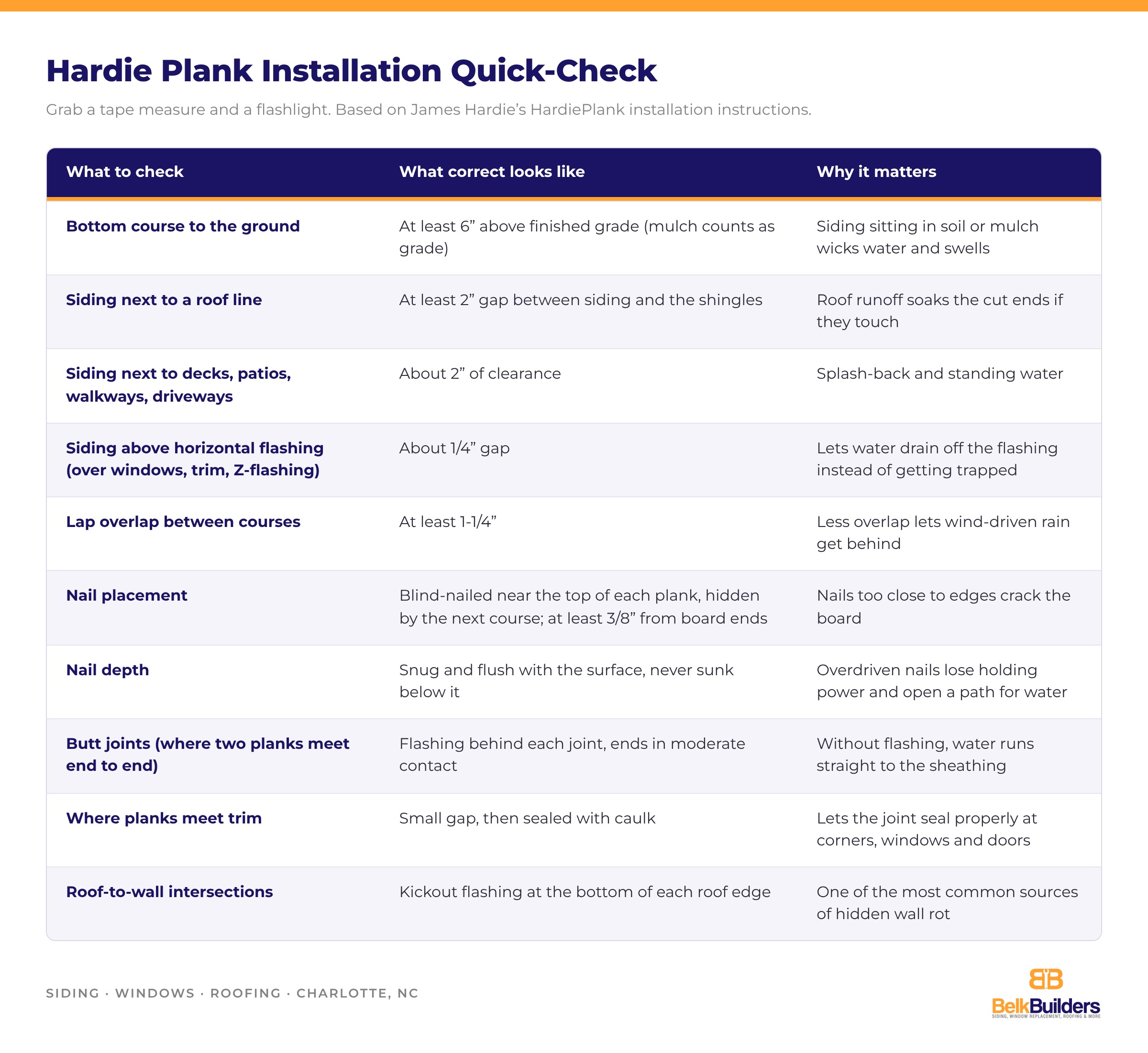
You don’t need to be a contractor to spot most Hardie installation mistakes. A tape measure, a flashlight and a slow walk around the house will tell you a lot. Everything below comes from James Hardie’s own HardiePlank installation instructions and from the problems home inspectors flag most often.
Warning signs you can see
Puffy, flaking bottom edges. Fiber cement doesn’t like sitting wet. Give it long enough and the edges puff up, go soft and start shedding. When we see that on the lowest course, or right where the siding meets a roof or deck, the first thing we grab is a tape measure, because the clearance is almost always short.
Cracked boards at the nails or the ends. Somebody nailed too close to the edge, shot the nail in crooked, or had the compressor cranked too high. Sometimes all three.
Nail heads you can see on lap siding. Hardie’s preferred method is blind nailing through the top of the plank, where the next course covers it. Face nailing is allowed in some situations, but rows of exposed, dimpled or caulked-over nail heads on a standard lap wall suggest a crew that rushed. One more thing on ColorPlus: Hardie’s instructions say flat out not to caulk the nail heads. The right fix is the little touch- up applicator that matches the factory color.
Open butt joints. If you can see house wrap (or worse, daylight) where two planks meet end to end, there’s probably no flashing behind that joint, or the boards were never snugged up to each other.
Caulk in the wrong places. Caulk belongs where siding meets trim, windows and doors. It does not belong along the bottom edge of every plank. Sealing the laps traps any water that gets behind the siding and keeps it from draining out. A house with a bead of caulk under every course is a red flag.
Wavy or uneven courses. Lines that dip or wander usually come from skipping layout lines, uneven framing that wasn’t shimmed, or planks that weren’t checked for level as the crew worked up the wall.
Stains streaking down from the roof or windows. Dark streaks below a roof edge or window corner often mean missing kickout or head flashing.
Peeling or chalky paint on primed boards within a few years. Primed Hardie needs to be painted with a quality exterior paint within the manufacturer’s timeframe after install. Long delays, cheap paint, or unpainted cut edges lead to early failure.
Plastic film still on ColorPlus boards. ColorPlus planks ship with a protective laminate sheet that’s supposed to come off right after each course goes up. Leftover strips stuck under a lap are a small sign of a careless crew.
Signs you can’t see from the yard
Some of the worst problems are behind the siding, and you’ll only find them by pulling a board or having a pro inspect:
• No house wrap or weather-resistive barrier, or wrap that’s torn and not taped
• Hardie installed directly over old siding
• No flashing tape around window openings
• Rotten sheathing that was covered up instead of replaced
• The wrong HardieZone product for the climate
What to do if you think your Hardie was installed wrong
1. Take photos and measurements of every spot that worries you, with a tape measure in the frame.
2. Find your paperwork. Look for the contract, the workmanship warranty and whether the James Hardie warranty was registered.
3. Call the original installer first and give them a chance to fix it in writing.
4. Get an independent opinion from a Hardie-credentialed contractor or a home inspector if the installer won’t respond.
5. Act before the damage spreads. Water behind siding doesn’t fix itself. A few boards near a roofline are a small repair; a whole wall of rotted sheathing is not.
We do a lot of repair and replacement work on siding other crews installed. If you’re seeing any of these signs, send us a photo or request a free estimate and we’ll tell you honestly whether it’s a spot repair or something bigger. Our guide to Hardie Plank siding replacement in Charlotte walks through what a full replacement looks like.
Frequently Asked Questions (FAQ's)
How much does it cost to side a house with Hardie Plank in Charlotte?
Most Charlotte homes land somewhere between about $18,000 for a smaller ranch and $45,000 or more for a large two-story with lots of trim. Square footage, height, the number of windows and doors, ColorPlus versus primed, and how much rotted sheathing turns up all move the number. A site visit is the only way to get a real figure.
Is Hardie Plank really worth it over vinyl in Charlotte?
For homeowners staying put for a decade or more, usually yes. In the 2025 Cost vs. Value data for Charlotte, fiber cement siding returned more than its cost at resale, while vinyl returned a bit less than its cost. Vinyl is still a solid choice for tight budgets, rentals and short ownership timelines.
How long does Hardie Plank last compared to vinyl?
James Hardie backs its siding with a 30-year non-prorated limited warranty and properly installed fiber cement commonly lasts well beyond that. Vinyl lifespan depends heavily on grade and sun exposure. Thin vinyl on a south-facing Charlotte wall can look tired in 15 to 20 years.
How long does a Hardie siding installation take?
For a typical home, about one to two weeks from tear-off to final walkthrough, depending on size, how much repair the sheathing needs, and weather.
Can Hardie Plank be installed over my existing siding?
It shouldn’t be. Covering old siding hides rot and makes it impossible to flash and nail the new boards correctly. A reputable installer removes everything down to the sheathing first.
Can I install Hardie Plank myself?
We don’t recommend it. The boards are heavy and fragile until they’re fastened, cutting them produces silica dust that requires proper saws and dust control, and small mistakes in nailing or clearances can void the warranty.
Does Hardie siding need to be painted?
Primed Hardie does, soon after installation and then periodically. ColorPlus boards come with a baked- on factory finish backed by its own 15-year limited warranty, so most owners go many years without repainting.
Do you install both Hardie and vinyl?
Yes. Belk Builders installs Hardie Plank, CertainTeed, Alside, Mastic and Ply Gem vinyl siding, plus vinyl trim, across Charlotte and the surrounding service areas.
The Bottom Line
Vinyl costs less on day one. Hardie Plank costs more, holds up better to Charlotte’s heat, storms and humidity, and has been one of the best-returning exterior projects in this market. But either one is only as good as the crew that hangs it. Ask hard questions, read the scope line by line, and walk around the house with a tape measure once the job is done.
If you’d like a second set of eyes, Kent Frerichs, owner of Belk Builders, comes out to look at every house himself before we quote it. There’s no charge and no sales script. Request a free estimate, contact us, or call 704-400-4710. We work throughout Charlotte, South Charlotte, Ballantyne and Blakeney, Lake Norman, Fort Mill and the rest of our service areas.
Kent Frerich – Owner Belk Builders
Related reading from Belk Builders:
• Charlotte Hardie Plank Siding Replacement: Your Comprehensive Guide
• Huntersville Hardie Plank Siding Installer
• The Power of Insulated Vinyl Siding in Charlotte
• Elevate Your Charlotte Home with Hardie Plank Siding’s Rich Palette
• Iron Gray Is James Hardie’s 2026 Color of the Year